
Evaluación de la actividad antimicrobiana de los extractos etanólicos y aceites esenciales de las especies vegetales Valeriana pilosa, Hesperomeles ferruginea, Lyrcianthes rhopaloides y Passiflora manicata frente a microorganismos patógenos
Article Sidebar
Main Article Content
Abstract
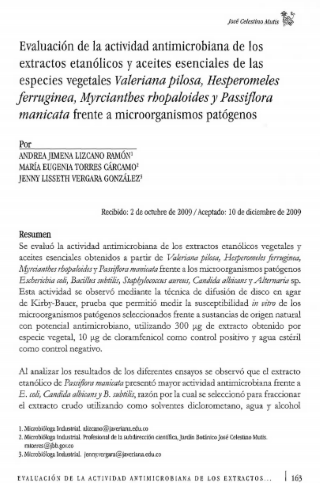
The present work was performed in order to observe and determine the antimicrobial effect of ethanolic plant extracts and essential oil Valeriana pilosa, Hesperomeles ferruginea, Lyrcianthes rophaloides and Passiflora manicata. These species were tested against the pathogen microorganisms Escherichia coli, Bacillus subtilis, Staphylococcus aureus, Candida albicans and Alternaria sp. For the obtainment of the ethanolic extracts we used dried plant material that was previously crushed; this was cold macerated using ethanol as a solvent during 48 hours. We used reflux ethanol-water (9:1) in order to concentrate it in a reduced pressure. For the obtainment of the essential oil from the leaves of Myrcianthes rophaloides we used the hydrodistillation technique. After, we measured the antimicrobial activity using the diffusion disc agar technique of Kirby-Bauer. This technique allows us to measure the in vitro oversensitivity of the pathogen and phytopathogen microorganisms, to the natural origin substances, which have antimicrobian potential. We took 300 µg of each extract, using 10 µ.g of cloramfenicol as a positive control and water as a negative control.
As a result of the different tests, we observed that the ethanolic extract of Passiftora manicata had a better antimicrobial activity against E. coli, Candida albicans and B. subtilis. For this reason we chose the extract of Passiflora manicata and divided it using dichloromethane, water and isoamilic alcohol as solvents. We found that the aqueous phase showed the highest antimicrobial effect against all the evaluated microorganisms. The results for the essential oil which was obtained from the leaves of Lyrcianthes rophaloides showed that Candida albicans was inhibited the most. In this work we concluded that Passiflora manicata was the ethanolic extract that showed the best results against all the microorganisms, permitting the division with the different solvents. We identified that the aqueous phase was responsible for all of the principle actions because there was the antimicrobial potential. In order to continue future investigations about antimicrobial potential of plant species it is necessary to find and isolate the specific molecule able to inhibit the microorganism chosen.